English
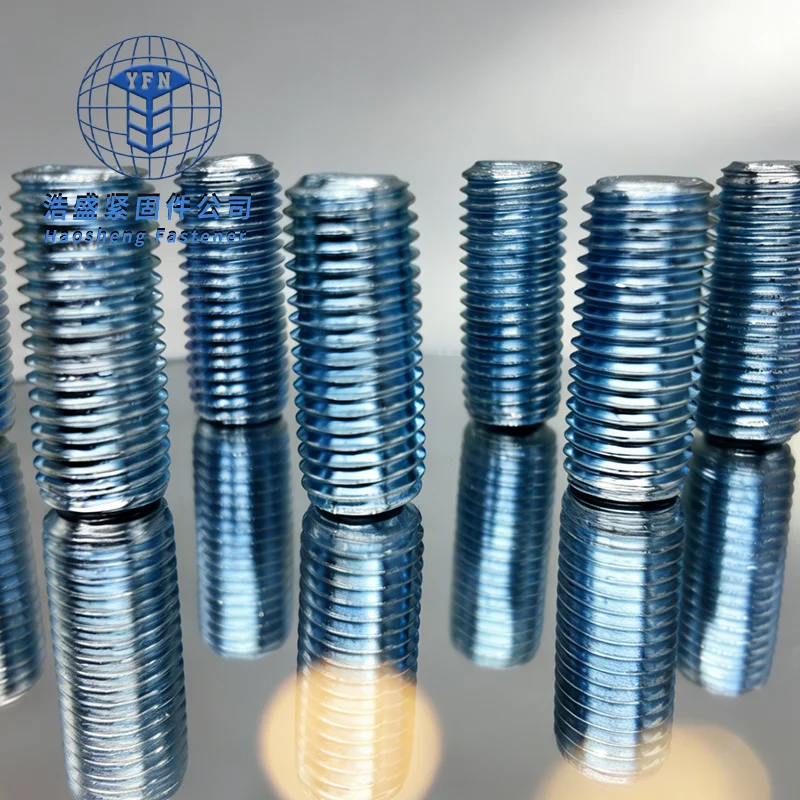
DIN 916(K) knurled cup point set screws (serrated grub screws) feature knurled teeth on the cup tip for strong mechanical grip. They are widely used for fixing gears, pulleys and shaft collars against rotation and vibration. We provide carbon steel, alloy steel and stainless steel versions with black oxide, zinc, zinc flake and other finishes. Samples are available.
Haosheng Fasteners supplies DIN 916 (K) knurled cup point set screws, headless fasteners driven by an internal hexagon socket and fitted with a cup-shaped point whose knurled teeth bite into the mating surface. They are used to hold gears, pulleys, shaft collars and couplings in position on a shaft, improving positioning and resistance to rotation in transmission and mechanical assemblies.
DIN 916:1980-12 is a withdrawn legacy designation, now covered by ISO 4029:2026 and its German adoption DIN EN ISO 4029:2026-06. The suffix (K) is a market style identifier for a knurled or serrated cup point, not part of the standard designation, so the exact knurl profile is confirmed against the technical drawing or a physical sample. Carbon steel, alloy steel and stainless steel options are specified by hardness class under ISO 898-5 or ISO 3506-3, with 45H a commonly available steel class. Plain, black oxide, phosphate, zinc electroplated and zinc flake finishes are available; stainless parts can be cleaned and passivated. Steel sizes run M1.6-M30 and stainless sizes M1.6-M24, product grade A. These set screws are not intended for tensile loading, and the knurled point may indent the shaft surface.
| Historical Designation | DIN 916:1980-12 (withdrawn) | Current Standards | ISO 4029:2026 / DIN EN ISO 4029:2026-06 |
|---|---|---|---|
| Product Form | Headless Set Screw | Drive Type | Internal Hexagon Socket |
| Point Style | Knurled Cup Point (K) | Product Grade | A |
| Size Range | Steel M1.6-M30 / Stainless M1.6-M24 | Hardness Class | 45H (ISO 898-5) |
| Surface Finishes | Plain / Black Oxide / Phosphate / Zinc / Zinc Flake | Samples | Available upon request |
Technical note: ISO 4029:2026 is the fourth edition, published 2026-02 and replacing the withdrawn ISO 4029:2003; DIN EN ISO 4029:2026-06 is the German adoption replacing DIN EN ISO 4029:2004-05. M30 was added for steel set screws only. The hexagon socket widths across flats run from s = 1.5 mm at M3 to s = 12 mm at M24, with s = 14 mm at M30, and coarse pitches from 0.5 mm at M3 to 3.5 mm at M30. These are standard cup point dimensions; the knurled (K) tip profile, actual lengths and available size combinations are confirmed by the drawing or sample. Set screws are selected by hardness class, not by the tensile property classes used for bolts, and ISO 4029:2026 states they are not intended for use under tensile load. Before substituting a current-version part for a legacy DIN 916 item, check the drawing, mating dimensions and permitted shaft indentation.
Serrated teeth on the cup rim bite into the shaft, adding mechanical resistance to rotation beyond plain rim friction.
With no projecting head, the screw sits flush with or below the hub surface inside a tapped hole.
A matching hex key tightens along the screw axis, giving controlled installation where external clearance is limited.
Steel parts are specified by hardness class such as 45H under ISO 898-5, not by bolt tensile property classes.
Carbon, alloy and stainless options pair with oxide, phosphate, zinc or zinc flake finishes; stainless can be passivated.
Thread, length, socket size, knurl profile, material, hardness and finish are confirmed from drawings or samples.
 |  |
 |  |
The applicable edition, the (K) style and the required knurl profile are checked against drawings or samples before quotation.
Carbon, alloy and stainless grades are verified with the specified hardness class under ISO 898-5 or ISO 3506-3.
External metric coarse threads and body length follow product grade A dimensional requirements for each nominal size.
Cup geometry and serrated rim are formed to the agreed profile, with contact marking on the shaft considered in selection.
Width across flats, socket depth and drive fit are checked so the matching hex key seats and tightens correctly.
Coating processes are matched to hardness and thread fit, with cleaning and passivation available for stainless parts.
| Comparison Feature | Plain Cup Point Set Screws | Haosheng DIN 916 (K) Knurled |
|---|---|---|
| Shaft Contact | Smooth annular cup rim | Serrated teeth bite into the surface |
| Rotation Resistance | Friction from rim pressure | Mechanical grip from the knurl |
| Vibration Service | More dependent on preload | Better resistance to loosening |
| Shaft Surface | Light circular marking | Visible indentations possible |
| Typical Use | Repositioning, softer shafts | Permanent positioning, harder hubs |
Selection note: Set screws provide clamping force, positioning and resistance to rotation. ISO 4029:2026 states that they are not intended for use under tensile load, so they must not be substituted for connecting bolts. Evaluate a knurled cup point carefully where shaft indentation is unacceptable, frequent disassembly is planned, or significant impact loads are expected, and confirm installation torque and contact surface conditions. When ordering, state the thread size, length, knurled point requirement, material, hardness class and finish; a drawing or sample is the reliable basis for the (K) tip profile.
No. DIN 916:1980-12 has been withdrawn. The current route is ISO 4029:2026, adopted in Germany as DIN EN ISO 4029:2026-06. DIN 916 remains common on legacy drawings and catalogues, so state the edition and required dimensions when ordering.
(K) is a market style identifier for a knurled or serrated cup point, not a standard clause. The DIN 916 number alone does not define the tooth profile; send the tip drawing or a physical sample to confirm it.
No. ISO 4029:2026 explicitly states that set screws are not intended for use under tensile load. They provide clamping, positioning and rotation resistance, and should not replace connecting bolts.
Carbon steel, alloy steel and stainless steel. Steel hardness classes are selected from ISO 898-5, with 45H commonly available; stainless grades follow ISO 3506-3. Bolt tensile property classes do not apply to set screws.
Product grade A, steel M1.6-M30 and stainless M1.6-M24. M30 is newly added in the 2026 edition for steel only. Finishes include plain, black oxide, phosphate, zinc electroplating and zinc flake; stainless parts can be passivated.
The teeth can leave indentations and the cutting edges deform after tightening, so reuse is not recommended. For finished shafts or frequent repositioning, review a plain or flat point. ISO 9001, ISO 14001 and ISO 45001 certified production; samples on request.
Please include the thread size, length, knurled point requirement, material, hardness class, surface finish and quantity. A tip drawing or physical sample is the best way to confirm the (K) knurl profile.
Contact Us


Hit enter to search or ESC to close
If you are interested in our products, you can choose to leave your information here, and we will be in touch with you shortly.